Sunday, November 28, 2021

Bathtubs, Boosters, and Bears, Omicron!! [A Holiday Update]

On November 24, 2021 I decided to get my fourth shot of the COVID19 vaccine.  The first two doses (Astra-Zeneca) were administered in a vaccine trial in November and December of 2020.  The next single shot (Johnson & Johnson) was given in May, 2021.  Did I medically need a fourth shot in order to have the maximal protection from COVID and its variants?  The answer involved a lot of math, a lot of probabilities, and a lot of maybes.  Ultimately I opted to receive the next dose (Pfizer) because it removed uncertainty, cleared up my ambivalence, and helped me to feel in control over what happens to my body. 

When I made this pre-Thanksgiving announcement on Facebook I received much support from family and friends.  One person, however, whom I would describe as vaccine ambivalent, privately reached out and asked, “So what does this mean?  That you’re going to keep getting booster shots over and over?” My answer:  YEAH!!  I will happily get COVID booster shots as long as it takes.  You’re talking to the same guy who regularly uses PrEP to prevent HIV and doxycycline to prevent STIs.  The idea of utilizing biomedical interventions to enhance my quality of life and reduce harm is hardly an unusual concept for me.

About 24 hours later media headlines started swarming around the World Health Organizations’s announcement of Omicron as a “COVID variant of concern.”   At the time of this writing, there is no clear evidence that Omicron is more likely to lead to illness than the other variants, nor how well the current vaccines protect from this new strain.  But I do know that having an additional booster shot offers me a way to feel proactive, responsible, and empowered about my pleasure and protection, in the midst of more panic and uncertainty. 

Damon in Mike Enders' Tub
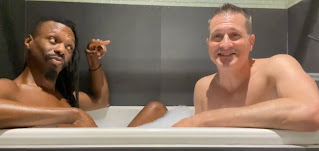
This theme of seeking medical and mental safety in times of turbulence and trauma has come up frequently in my new “Tub Talks” series.  The idea of doing naked interviews in a bathtub came to me years ago, when I saw my buddy Mike Enders, aka as “The Accidental Bear” holding court in his tub in San Francisco.  I begged him to let me be part of his show, and we filmed a very fun episode in early 2018.  Mike was already moving beyond his bathtub to focus on animal activism by that point, and I thought eventually I wanted to host a similar type of forum for discussions, dialogues, and deeper lessons about resilience and hope. 

After finishing my 50 Lessons of 50 Series last Spring, I began planning  “Tub Talks With Damon" -
Kareem McJagger In The Tub
...featuring naked conversations with thought leaders, artists, healers, creators, bears, and people who just fascinate me.  All have generously shared experiences of vulnerability, as well as lessons learned from surviving pain.  Everyone who has visited my Tub has deepened my appreciation for overcoming obstacles, fighting to gain a sense of safety and control after dealing with traumatic setbacks, and using their experiences of adversity to help improve the lives of others. 

Monday, September 13, 2021

Tub Talks With Damon Premieres Today

On this pilot episode of Tub Talks, Damon learns from Matt how he transitioned from occupational therapist to sex worker. What are the pros/cons of doing porn and sex work, and how can we celebrate the beauty of our bodies as we get older? 
 
Plus - Why the heck are we doing interviews in the bathtub? 


Monday, July 19, 2021

10 Years Of Taking PrEP

I began using PrEP 10 years ago today.  I'm clarifying some myths, fears, and inaccuracies in this statement.  Please take time to learn more at PrEP Facts: Rethinking HIV Prevention and Sex!

Sunday, April 25, 2021

1. The Joy Of Aging: Power, Purpose, Pleasure

I was 14-years-old when The Breakfast Club was first released in theaters and I would end up seeing it many times during its original release.   As much as I enjoyed it, I did disagree with a central premise of the film, and seemingly all the John Hughes angst films in that genre.   In a scene where all five characters discuss their fears and vulnerabilities, Ally Sheedy’s character laments, “It’s unavoidable.  It just happens. When you grow up, your heart dies.”  I remember thinking, “No, it’s not unavoidable.  That doesn’t have to happen!” 


I am turning 50-years-old today as I'm writing this filled with more heart, more gratitude, more optimism than I’ve had before.  One of the benefits of living this long is knowing that when I feel hopeful it’s not coming from idealism or naivety.  I’ve seen good and bad, I’ve seen highs and lows, I’ve experienced the best and the worst.  I’ve seen beauty and miracles unfold in this world.  And in the last 14 months I believe I’ve seen the ugliest humanity has to offer.  Nevertheless, I write this carrying a strong rational faith that there is much joy ahead.  

About two decades ago I came to understand that most feelings aren’t about what happen to us, they are about the meaning we give to the events that happen to us.  If you don’t like the feeling, change the thinking.  So the faith I’m feeling today isn’t about things going well for me in my future, it’s about knowing that my reactions to what’s unfolding around me are largely guided by an energy of love, forgiveness, peace, and resilience.  I trust Damon now in a way I didn’t when I was younger, I like Damon now in a way I didn’t before. I’ve respect who I’ve been, I dig who I’m becoming.   This is very different from the scenario of adulthood described by the kids in The Breakfast Club. Over the past 49 days I’ve shared lessons I’ve learned that have helped me to reach fifty with my heart in check, my soul aligned, my body ready to take action.  All of the previous entries were building toward my “trifecta” of focusing on the power, purpose, and pleasure, that can help us to age with ascension, confidence, and lots of fun.   Here’s what each of these looks like to me:

POWER:  This is not power over others as it is typically described in capitalistic terms.   My concept of power here is about the true power that lies within us, our connection with that God or Spirit or Higher calling that is not contingent on another person’s validation or attention.  It is the connection we foster and maintain within ourselves, ways we tap into the abundant energy of love that is in us and around us.  This is basically the opposite of what we are conditioned to do in the United States, which is use blame, shame, criticism, and attack, to respond to fear or discomfort.  Our true empowerment is something we were born with, it is a beautiful force we already carry.  You don’t need therapy or a drug to find it, it’s already a part of who you are now.  

When we don’t cultivate and nurture our true power, we become a “leaf” that is reactive to the opinions and judgments of those around us.  This is especially in challenging for gay men who simultaneous crave attention, but perpetuate ageism.  If your sense of identity and confidence is contingent on men finding your desirable, then you are setting yourself up for much pain and suffering in the years ahead.  

There is an easier way!  Begin the process of decoupling the true self from the social self.  Actively nurture and maintain your love for your true self, knowing that that peace and confidence will affect the attention you get with your social self, not the other way around.  These techniques and tools were covered in Lessons 48, 47, 43, 42, 40, 33, 27, 26, 22, 20, 19, 15, 13, 11, 9, 7, 5, and 3.  
   

PURPOSE:  We all need a reason to get out of bed in the morning.  Or in some cases, maybe the afternoon.  Either way, it is important in all stages of life that we feel our lives matter, our contributions are relevant, our hearts are included.  I believe we all have “Work” we do that helps us to feel like we’re contributing meaningfully in the world.  For me that Work has always been related to mental health and service, but people can experience this through their artistic achievements, their sports activities, volunteer work, their hobbies or recreational interests. It doesn’t matter as much what it its you are doing, just so long as it maintains that there is a reason we are living on this planet at this time in this body, and our energies are called upon at this point to help somehow make the world a better place .

Without purpose people often feel obsolete and irrelevant.  If they don’t feel like they have a reason to get out of bed then they may not get out of bed.  I have seen people falter at these times, sink into depression, escape into alcohol or drug abuse.  We are living in an ageist society that continues to tell people they become less relevant and have less to contribute as they get older.  I think that might be changing, as more and more people in their late 70s maintain positions of significant political significance in government.  

Nevertheless we are taught it is the goal to “retire” and slow down as we age.  If that feels right to you then that is a beautiful thing.  But if you feel you have something to share, something urgent to say, something relevant to express, then it will be incumbent on you to find ways to channel that message throughout the different stages of life.  Different suggestions about finding purpose and meaningful Work were covered in Lessons 46, 44, 41, 39, 38, 36, 35, 34, 30, 28, 24, 23, 18, 10, and 8.

  
PLEASURE:   This almost always gets left out of conversations about aging, especially when we’re talking about sex.  Especially when we’re talking about gay sex.  Especially when we’re talking about a lot of gay sex with a lot of different partners that doesn’t result in some horrible catastrophe, and instead leaves all participants with a sense of connection, fun, and some groovy oxytocin.  But “pleasure” is not limited to the sexual realm — in my opinion it involves anything fun on the tactile level. It might be sports, it might be hot air balloons, it might mean riding horses, it might mean traveling to a new country.  Anything that heightens sensation and affirms your life experience can be pleasurable.

We know that babies need a consistent amount of affectionate touch and holding in order to physically and cognitive thrive.  At what age does that stop?  I don’t think it ever does, but I do think American culture discourages us from asking for physical touch, intimate connection, sexual vulnerability, especially as we get older.  When people are involuntarily celibate they often feel loneliness, depression, and express irritability and rage.  This need not be!

What if we normalized consensual touch and sensuality as a regular part of human connection at all stages of life?  What if we respected the role of human contact and oxytocin as an integral part of healthy aging?  What happens when we nurture curiosity to seek out fun and playful connections with others?  How would we feel if  we used our agency to clearly articulate our “Yes,” or “no,” and our “mmm, maybe.”  I explored these themes in great depth in Lessons 50, 49, 45, 37, 32, 31, 29, 25, 21, 17, 16, 14, 12, 6, 4, and 2.  

 [Thank you Adam's Nest]

I believe we have an unprecedented moment here.  As a gay man I have never lived in a time with this level of social acceptance, legal protections, medical advancements.  I am starting a new decade of life with the U.S. starting a new decade with great potential for recovery, healing, and growth. When we put together power, purpose, and pleasure we develop the limitless opportunities of expansion, enlightenment, and connection that lie before us as we get older.  I’m so glad to be on this journey, and continuing these ideas and conversations in the years and decades ahead.  
 
*Thank you Adam Singer for all the graphics developed for this series, and proofreading my typos!! 💜 

 Damon L. Jacobs is a Licensed Marriage and Family Therapist helping individuals and couples enjoy life with peace, purpose, and pleasure. His books "Absolutely Should-less" and "Rational Relating" help people experience connection with joy, serenity, and meaning. His work has been featured on CNN Health, The New York Times, MSNBC, USA Today and more. He can be reached at Damon@DamonLJacobs.com or 347-227-7707


Saturday, April 24, 2021

2. Now Is Our Time For Fun

I am a part of one of the fiercest and most resilient generation of queer folks that has ever existed.  Most LGBTQ individuals my age and older had to grow up in a time when society directed hostility and violence toward people who aren’t straight. We often had to compartmentalize our personalities, lower our voices, make sure we didn’t shine too bright as to draw suspicious attention.  We had to be afraid that our bodies could be deadly vectors of disease that could harm others. We had to grow up in communities, churches, and schools, that constantly instructed, “be less than you are.”  Not a lot of fun.

I had no queer role models growing up, no one to look up to or follow.  The gay and lesbian teachers in my high school had to remain closeted and couldn’t be a direct source of support or information even if they had wanted to be.  There were no representations on television that I can recall which portrayed an LGBT person as happy or successful.  I do recall an occasional movie here or there but they were mostly limited to the “Monty” stereotype in the movie Fame.  He was not as tragic as the doomed protagonists of Suddenly Last Summer or The Children's Hour, but not exactly someone you aspired to emulate either.  The insidious message was if your gay you’re doomed to be depressed, ostracized, lonely, and potentially a victim of violence.  

Those who overcame these obstacles in the 1970s befell another tragedy in the 1980s:  The AIDS crisis.  From seemingly out of nowhere, a cruel and deadly virus struck the U.S. hitting gay communities significantly harder than other populations.  The association was made clear to all of us:  sex can result in death, pleasure may lead to disease, vulnerability can give you a virus.  I came out during this time only knowing sexuality as something dangerous that must be protected by a latex barrier.
 
Sodomy laws in the U.S. made anal and oral sex a crime, and were enforced almost exclusively against gay men.  The Supreme Court upheld state rights to prosecute gay men for sodomy in 1986, and these were used to threaten, intimidate, and criminalize sex between consenting adults in many states up until 2003.  The message was clear:  Hide who you are, be ashamed of your sexuality, and if you don't you may face exploitation and  jail time. 
    
Many who were in a emotionally bonded relationships during these years faced an additional trauma: being separated by their partner’s family during and after their death.  There were no legal unions then, so even if you had been in a committed relationship for years, you had no legal right to stay by your partner’s side in the hospital.  Healthcare institutions could legally remove you from caring for your loved one without any cause whatsoever.  Their families could easily ban you from visiting as well.  After their death, there were no protections promising you would still have a place to live or any of the financial benefits that legal heterosexual marriages enjoyed, even if the deceased had made a legal will.  Every clinic I worked and volunteered in had clients who were homeless and destitute after their partner’s homophobic family had exiled them.  They simply had no legal claim on their beloved’s property or financial gains if the family disputed them.

In other words, things were rough.

Friday, April 23, 2021

3. Someday I Will Die

When I was in tenth grade I played a forest ranger in what perhaps might be the silliest musical ever produced titled, “Little Mary Sunshine.”  I can’t even remember what the show was about, but I do remember an important lyric from the showstopper “Mata Hari”: 

“As she died she said, ‘What fun! It’s the only thing I haven’t done!'”

At 16-years-old I vividly recall saying, “Yes that’s how I want to go out too.”  

At 50-years-old I am well aware I am in my second act.  I don’t think I’ve had my showstopper yet, but I’ve had a hell of a soundtrack.  I know that I have less time in front of me than I do behind me.  At the same time I see gun violence escalating which reminds me I may not get as much time as I would like.  Every day in the United States there are mass shootings and there is no clear end in sight.  I am not at all afraid of dying, I’m just afraid of not living while I’m still alive.  

Even as a teenager I was cognizant of the fact that it was more important for me to live a life of variety, curiosity, and adventure rather than to stay in one place, only have one partner, only do one thing for work.  I wanted to live a life that was filled with highs and lows, joys and sorrows, victories and setbacks.  I didn’t mind losing a game or getting hurt, just so long as I played hard and gave it my best.  So when all was said and done on my death bed I could sing the Mata Hari song and mean it. [FYI — the version of the song that has this verse is on the 1962 soundtrack, not the 1959 rendition, because the world needed two distinct versions of Little Mary Sunshine].  
  

One of the many things I am grateful to have learned on this journey is the relevance of balance.  The Buddhist yin yang symbol represents perfect symmetry and respect for all energies.  It illustrates that we cannot have true joy without true sorrow.  We cannot really laugh unless we can really cry.  We can’t truly celebrate until we can truly grieve.  We can’t appreciate health if we can’t respect sickness.  And we can’t fully embrace life unless we can fully embrace death.  Our ability to feel one is directly proportional to the ability to feel the other.  My life would not be fulfilling, meaningful, and really fun in the now, if I didn’t fully recognize and respect the fact that my body will someday die.  

Thursday, April 22, 2021

4. Great Sex = Safety + Agency + Discovery

Talking with people around the world about sex and pleasure has been one of the greatest rewards of my personal and professional career. It is also so different from the world I grew up in where people did not talk about sex openly or casually.  I knew whatever Doug and Julie were doing under the covers on Days Or Our Lives looked like fun, I just didn't understand what it was. Yes, I learned about reproduction and "birds and bees" but not about connection and gratification.  Yes, my high school played a video with Whoopi Goldberg telling us to use condoms to prevent AIDS but no one actually talked about enhancing pleasure or intimacy.  Gay men love to share explicit pictures and porn but rarely ever communicate how they'd like to be touched or held.  Much of my Work is about changing the paradigms of fear and shame that keep sex depersonalized and separated from joyful aging.  I have been doing that in recent years by focusing on the model: Great Sex = Safety + Agency + Discovery .   I will explain each  below. 

SAFETY - This means having an experience of protection from imminent risk.   It is an understanding that sex, like every physically playful activity on earth, involves negotiating a modicum of harm-reduction and risk reduction.  This operates on several different levels:
 
Physical:  In order to enjoy sex we must believe that our partners are not going to physically harm or do something gravely painful to our bodies.  We must have reason to believe we will not be traumatized or permanently injured during this encounter. 
 
Medical:  This is the confidence that sexual pleasure won’t result in a life-changing medical event.  I never had sex completely free of fear of HIV until I started using PrEP at forty-years-old.  The science of U=U has since proven that someone who is living with HIV and undetectable cannot sexually transmit HIV to their partner.  Put these together and we have two significant ways of improving safety in sexual connections.  However, in spite of these biomedical advancements, people may still hold back from experiencing pleasure if they remain consumed by fear, and/or still struggling with trauma, as described in Lesson 50. 
 
Emotional:  In order to enjoy sex we need to know our partners will not willingly nor maliciously try to harm our emotional or mental health.  Feelings by their very nature can sometimes result in pain and loss.  But we have to also believe our partner is not intending to cause harm or damage, or seeking to use sex to cause mental pain or exploitation.  

None of this is to be confused with consensual risk or danger.  Many people are stimulated by intentionally creating a scenario that involves a level of physical pain, emotional exploitation, legal jeopardy. But again, that is an entirely different experience from the risks of being physically, medically, or emotionally in peril without agreement or negotiation.  

AGENCY - I define "agency" as the feeling that you can make things happen.  It means that on many or most occasions, if you’re interested in having sex, then you will have sex.  Whether that is with a primary partner, multiple people in your pod, or completely random hook-ups, you are aware that with genuine effort, the odds are in your favor.

With agency you have the ability to practice essentials like consent and communication. If you know that sex is available and abundant for you, then it’s much easier to say “yes” when your answer is yes, say “no” when your answer is no, and “maybe” when your answer is maybe.  It’s much easier with a sense of agency to clearly communicate your boundaries, consent, and what you prefer sexually.  It’s knowing you’ll have plenty of options to enjoy sex in your lifetime, so you need not shame people, coerce them, or react viciously, when you hear “no."